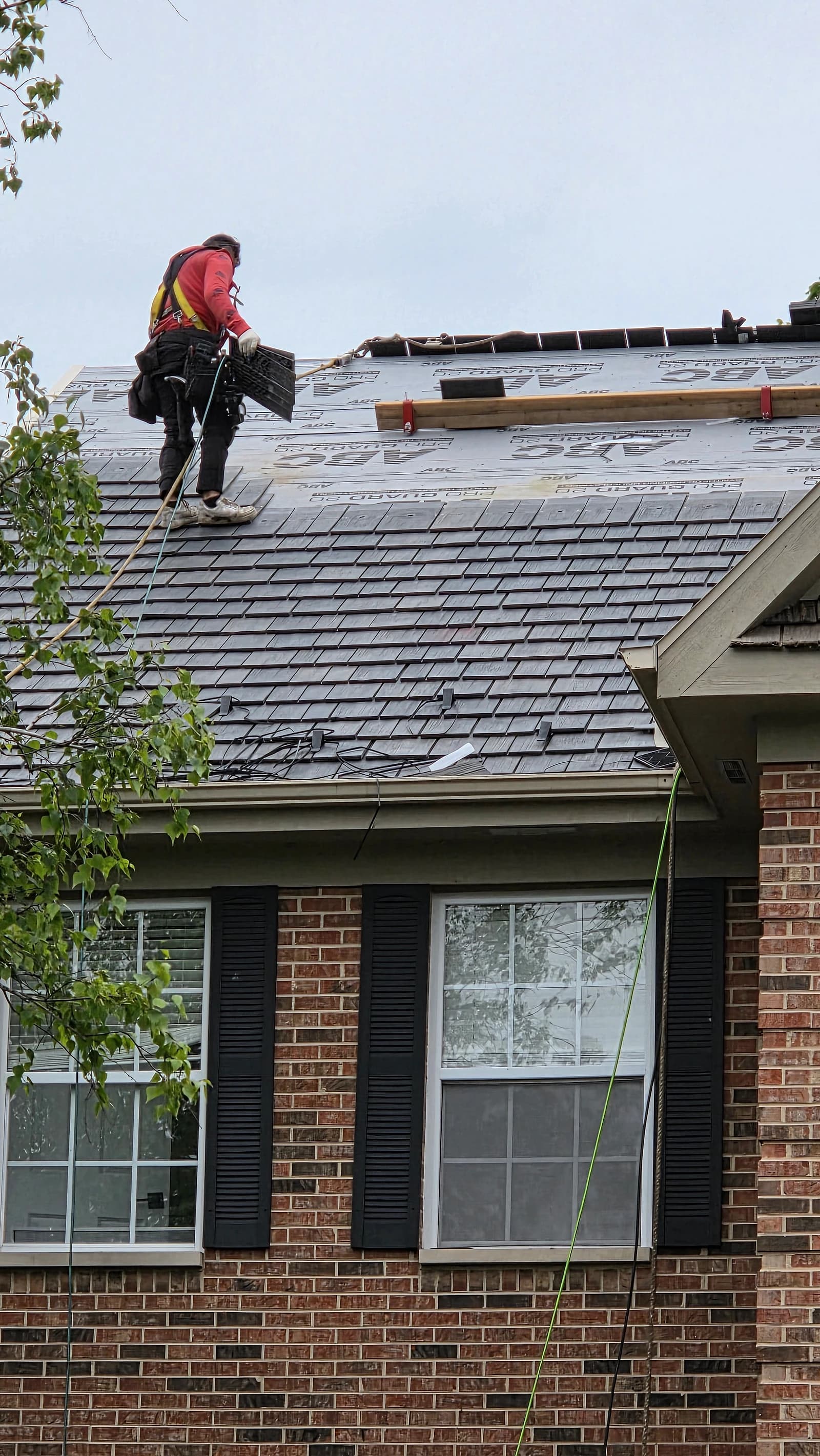
Most Atlanta storm roof damage I get called out for looks like nothing from the driveway. A homeowner up in east Cobb phoned me the morning after a July storm, sure the roof was fine. It was a clear day, no shingles in the yard, gutters still hanging straight. From the ground it looked like the storm had skipped his house. Then I got the ladder up, ran my thumb across the south slope, and felt the soft spots. That roof was already on a clock he couldn't see.
That gap between what the ground tells you and what the roof actually took is the whole reason I write these. The damage that ends a roof early after a summer storm is almost never the dramatic missing-shingle kind. It's quieter than that, and it hides in three places most people never check.
First, what actually hits your roof in an Atlanta summer storm. Three things, usually together: hail, straight-line wind, and whatever debris the wind throws. Our hail season peaks in March, April, and May, with a smaller bump in September and October, but summer is its own animal here. The afternoon pop-up storms that build over the metro in July and August carry plenty of hail and wind on their own. So "it's summer, hail season's over" is the wrong read. The storms just changed shape.
On size, the National Weather Service calls hail "severe" once it hits one inch across, about a quarter. Most of what falls around north Georgia runs one to two inches. The biggest stone ever recorded in the metro was about 2.75 inches, roughly a baseball, the one that fell in Austell back in 1998, and the metro has logged plenty of hail reports over the years. You don't need a once-in-a-decade stone to do real harm, which is the part most homeowners get backwards.
The three things I look for, and only one shows from the ground. When I'm on a roof after a storm, I'm checking for bruising, granule loss, and spatter. Two of the three are close to invisible unless you're up there with your hands on the shingles. Here's the short version, the part worth reading twice: bruising is a cracked shingle mat you have to feel for, granule loss is the slow leak that shows up two summers later, and spatter is the scary-looking mark that usually means nothing. Get those three straight and you understand more than most people who've owned a roof for twenty years.
Bruising is the one you have to feel for. When a stone hits hard enough, it fractures the fiberglass mat inside the shingle. The top surface can look completely intact while the mat underneath is cracked clean through. I press my thumb on the suspect spots and a bruised shingle gives a little, soft like a ripe spot on an apple. From ten feet up it looks identical to the shingle next to it. From your driveway you would never call it, and that's exactly why a storm "that didn't do anything" can still have set up a leak. I've pulled shingles off Cobb and Cherokee roofs where the top looked fine and the mat was split underneath, and the owner had been told "looks fine" from the ground twice.
Granule loss is the slow one you won't notice for two summers. Those little ceramic granules on the surface of a shingle aren't decoration. They're the sunscreen. Knock enough of them off and the asphalt underneath sits bare in the sun, dries out, and ages years faster than it should. You don't see a leak the week of the storm. You see it later, when that thinned-out spot finally lets water through and stains a ceiling. The tell from the ground is grit: black flecks in the downspout splash zone, a gritty line of sediment where the gutter drains onto your driveway, sandy buildup in the strip of mulch under the downspouts. That's your roof washing away one rain at a time.
Spatter looks scary, but it's mostly cosmetic. Spatter is where a stone knocked the dirt, oxidation, or lichen off a hard surface and left a clean mark, often on the fascia, the AC unit, or a vent cap. It proves hail was here, and the pattern even tells me which direction the storm came from. But spatter on its own doesn't mean your roof failed. Homeowners panic over the marks on the AC condenser and miss the actual bruising overhead. The spatter tells me hail showed up. The roof tells me what it did.
The myth that you need golf-ball hail to worry. This is the part the generic roofing pages still get wrong. A 2025 study out of the Insurance Institute for Business and Home Safety, published in Frontiers in Materials, found that repeated small hail, the sub-one-inch stuff nobody worries about, can strip more granules over time than a single two-inch stone. Worse, a roof that's already weathered and pelted by small hail came out roughly ten times more susceptible to damage in the next severe-hail storm. Read that again. The small storms you ignore are the ones quietly loading the gun for the big one. That single finding is why "it looked fine from the driveway" is the wrong test entirely.
What size hail does what. A rough field guide, since people always ask. Penny-size hail, under an inch, mostly leaves spatter and light granule scuff, usually cosmetic. Quarter-size at one inch is where standard three-tab shingles start taking functional damage. Around an inch and a quarter, the thicker architectural shingles most Atlanta homes wear start to bruise. Golf-ball hail at roughly an inch and three-quarters brings widespread bruising, mat fractures, and splits. By the time you're at baseball size, you're looking at serious structural damage. Most of what I find after a summer storm sits in that one-to-one-and-a-quarter-inch band, the range that does real harm while looking like nothing.
People also ask whether insurance requires hail to be a certain size before damage counts. There's no magic number that makes damage real or not. Your roof either took a functional hit or it didn't, and a size threshold on a chart doesn't change what's physically happened to the shingle. What matters is whether the mat is fractured and whether granule loss has bared the asphalt, which is a thing you confirm by looking, not by guessing at the stone size from the ground.
How to read your own roof from the ground, safely. You don't need to climb anything, and please don't. Stand at the downspouts and look for grit and granule piles in the splash zone. Walk the perimeter and check the gutters for dents and dings. Look at the AC condenser fins and any metal vent caps for fresh spatter or dimples. Scan the yard and the driveway for shingle pieces or an unusual debris field. Check window screens and the grill cover for impact marks, since those take hail at the same time the roof does. If you want the full step-by-step, I wrote out a 10-minute ground check and a longer guide to reading storm damage from the ground you can follow in your own driveway. None of it replaces a real look, but it tells you whether you need one.
If you want the bigger picture on why some Atlanta suburbs get hit far more than others, it's worth understanding the Atlanta hail belt. Where your house sits in the metro changes the odds more than most people realize.
Why who gets on your roof matters more in Georgia. Here's something a lot of homeowners don't know: Georgia doesn't issue a state roofing license. Roofing is an exempt specialty trade, so there's no state license number to check the way you'd check a plumber. Counties like Cobb, Cherokee, and Forsyth require permits on a re-roof, and that paper trail plus the company you actually trust to do the work is most of your accountability. That's why the owner writes every DJK quote instead of a commission salesman, and why every inspection ends with a written report and dated photos you keep.
What to do this week if a storm hit your area. Keep it calm and simple. Note the date the storm came through and roughly what fell. Take photos from the ground, the gutters, the splash zones, the AC unit, any debris. Then get a documented look from someone who'll actually be honest about what's up there. Hang onto that report for your records. You work with your insurer on the paperwork side; I work on your roof. That's the clean line, and it keeps everyone in their lane.
Most roofs that "look fine" after a summer storm really are fine, and I'll tell you so when they are. But some aren't, and the difference is granule loss and a bruised mat you can't see from the driveway, the kind of thing that turns into a stained ceiling two summers down the road. If a storm rolled through your part of the metro this season, let me get up there and check it the way I just walked you through, then hand you a written report with dated photos for your records. Thirty minutes on a ladder now beats a leak you didn't see coming. Book a free documented storm inspection and I'll come read your roof the right way.